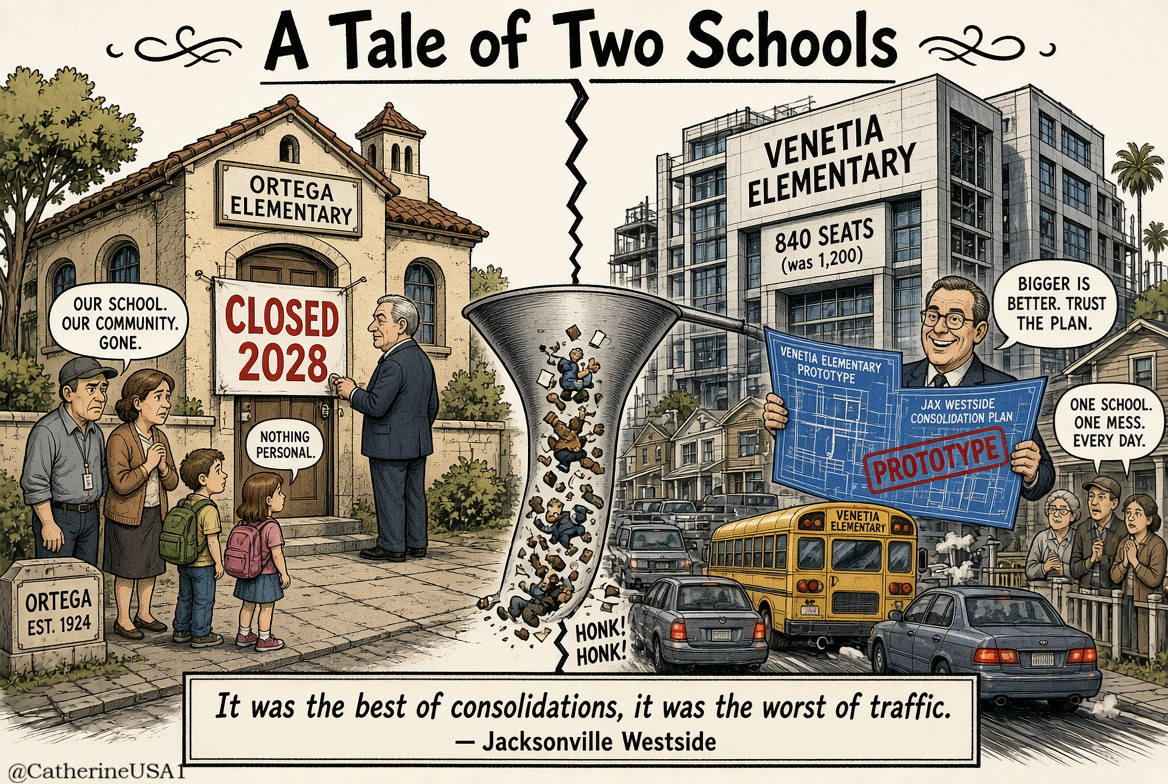
A Tale of Two Schools

The Duval County School Board and the central office spent the better part of 2026 treating the Venetia neighborhood like a blank spreadsheet cell.

Venetia Elementary, a 1942 building on Timuquana Road with roughly 350 kids, was going to be razed and replaced with a 1,200-seat “prototype” elementary.

Ortega Elementary, under 300 students, would be shut after 2027–28 and folded in. The original shut date was 2030.

The other 500 or 600 seats? Boundaries “to be determined later.”

Cost figures floated as high as the $70–75 million range before staff promised it would come in “well under $50 million.”

And the first concrete ask was a $2.2 million preconstruction contract so the design could start before anyone had answered the obvious questions.

Neighbors did the unglamorous work the district skipped.

They printed flyers, knocked on doors, and showed up.

They pointed out that Timuquana already backs up when the current school lets out.

They noted the site is landlocked, that drainage is already a local obsession, and that a neighborhood school you can walk or bike to is not the same thing as a regional campus fed by buses from somewhere else.

They asked, repeatedly, where the extra kids were supposed to come from.

The answers stayed vague because the real driver was utilization math and a 2019 facilities plan, not a traffic study or a straight conversation with the people who live there.

Neighbors on Timuquana are not inventing the traffic. A school that currently serves a few hundred kids does not magically absorb Ortega plus five new pre-K rooms without a car line that backs into the streets.

The process made it worse. Ortega’s closure advanced with the kind of quiet procedural speed that makes people assume the outcome was decided before the microphones were turned on.

Community meetings arrived with thin notice. A surplus-property move on Ortega drew the same complaint: the district was writing the ending before it finished the chapter.

The district ran a traffic study after the shouting started.

Parents at both schools said the process skipped its own rules.

Stockton families started asking who else was quietly next.

Superintendent Christopher Bernier eventually told a packed room he was “hearing” the Venetia community “very, very clear.” Hearing is cheap.

The $2.2 million contract still came up for a vote.

On September 1 the board finally blinked, 6–1, with only Tony Ricardo in favor. Chair Charlotte Joyce said the district had lost trust and had to get it back. That vote was the correct one, and it only happened because residents forced it.

A board that needs a hallway full of angry neighbors before it slows a multi-tens-of-millions project is not exercising oversight. It is reacting to embarrassment.

The revision that followed is not a conversion. Staff came back with 840 seats instead of 1,200, Italian-revival trim so the box looks less like a box, a traffic study, and a car queue sized for more vehicles than the model says it needs.

Ortega is still closing. Five VPK classes are still being added. The price is still in the neighborhood of $50 million. Approval is still aimed at a November board meeting, with an opening target of 2028.

Some Venetia parents, reasonably, want the falling-apart building replaced and said so; at the September 29 meeting they got booed by people who think the trees and the road matter too.

Both groups are arguing past a district that treated “right-sizing” as a mandate and community consent as a scheduling problem.

This is what the half-penny sales tax politics always risk becoming. Voters were sold repairs and smarter facilities.

What they got on the Westside was a prototype campus dropped onto a street that already fails at one-third the proposed load, justified by payroll efficiency and a Polk County-shaped floor plan, with the hard questions deferred until after the contract.

Consolidating two small elementaries can be defensible. Building a much larger school on a constrained site, while refusing to say who else is coming, and then acting surprised when the zip code objects, is not management.

It is a preference for clean capacity numbers over the actual place.

The September vote proved the board can still be moved.

The October “compromise” proves the central office would rather resize the same plan than abandon the premise.

Until Duval stops designing the school first and discovering the neighborhood second, every future closure is going to look like Venetia: a fight the district scheduled, then claimed it never saw coming.

A tale of two schools, sure—except both of them are being written by the same central office.

The Diary of an Incompetent Mayor by Donna Deegan

Dear Diary,

Woke up, checked the crime stats, closed the tab. If I don’t look at them, they can’t hurt me.

Spent the morning explaining that “equity” is a public-safety strategy and that the real emergency is whoever still uses the phrase “law and order.”

The press conference went well. I smiled, said “community,” and no one asked about the open positions in the police department.

Lunch with the consultants. They love the new slogan: “Jacksonville, but softer.”

We workshopped ways to rebrand the budget hole as an investment in vibes.

One of them suggested we stop calling 911 response times “response times” and start calling them “arrival journeys.”

Genius. I wrote it down.

Afternoon: another meeting about the homeless encampments. I proposed more studies, a task force, and a mural.

Someone mentioned enforcement. I told them enforcement is a colonial framework and changed the subject to shade structures. The room nodded. Nodding is how you know you’re leading.

Evening email from the city attorney. Something about contracts, deadlines, and “material noncompliance.” I forwarded it to staff with the note “pls handle, thx.”

Leadership is delegation.

Before bed I scrolled the comments. Half the city thinks I’m incompetent. The other half thinks I’m brave for being incompetent in the correct direction. I screenshotted the second half for the campaign folder.

Tomorrow: ribbon-cutting for a pilot program that pilots other pilot programs. If it fails, we’ll call it a learning experience and fund phase two.

Sleep well, Jacksonville. I’ve got this. Or someone on staff does. Probably.

Oops! They Did It Again!

The DCSB just handed a building over to a buyer that has no plan, no timeline, and a contractual escape hatch if they change their mind.

That is not a sale. That is a maybe, dressed up in paperwork.

Meanwhile the board has nowhere to go. No backup site. No ready alternative.

Just the comforting knowledge that they are allowed to take as long as three years to figure out what happens next.

Three years of limbo for a public asset, while the other side can walk whenever the numbers stop looking friendly.

A school board is supposed to protect capacity and continuity. Instead it has locked itself into a deal where the buyer holds the option and the public holds the risk.

If the company stays, fine. If it does not, the board is the one scrambling, late, and still free to deliberate at its own leisure.

That is not prudence. That is an exit clause for one party and a three-year shrug for everyone else.

Third Time Is A Charm

They’re doing it again. On October 6 the Duval County School Board is set to vote, once more, on selling the Southbank headquarters at 1701 Prudential Drive—this time to Ashco for about $15.1 million, with three years to get out and still no locked-in place to go.

Last fall they rejected a $20 million Fleet Landing deal over the payment structure, then flipped 4–3 and approved a $17.2 million sale to Chase Properties paired with a Baymeadows buy.

Chase walked in February after the community development district bond mess on the parking-lot parcel—roughly $6–8 million a private buyer would inherit—became a fight over what was disclosed.

Now the price is lower, the replacement site is still “to be determined,” and the board is being asked to sign the deed anyway.

That is not a strategy. It is a fire sale of prime riverfront land after the district already botched the last transaction.

Midtown is more central to the county’s population and closer to the communities the district actually serves; Baymeadows and the other Southside options are bigger and cheaper on paper and farther from the urban core.

The NAACP already called the earlier move a threat to alienate the people the board is supposed to represent. Board members who voted no last time compared it to the transportation outsourcing decision that later looked expensive and hard to undo.

Sell first, figure out the new office later, and hope the net proceeds survive appraisals, CDD baggage, moving costs, and whatever building they eventually overpay for. The headquarters has been there for decades.

Trading it for a smaller check and an open-ended relocation, after one deal already collapsed, is how you end up in a conference room five years from now asking what they were thinking.

Donna Deegan and Finance 101


So now Donna Deegan wants the people she parks on city boards to sit through a finance class.

Not because the public suddenly demanded literacy in bond covenants. Because JTA is cutting service over a deficit, JEA keeps hiking rates, and someone in the mayor’s office decided the fix is a free slideshow on how to read a balance sheet.

New appointees are “encouraged” to finish it within 90 days. Current ones get 180. Ethics, Sunshine Law, public records, pensions, credit ratings — the whole civics packet.

It isn’t mandatory yet. The order just nudges them, then she goes to City Council and asks to make the standards stick.

Encouraged today, required as soon as the votes line up.

That’s the tell. These are her appointees, confirmed to oversee real money at independent agencies, and the operating assumption is that they might not know a pension liability from a parking meter.

If the mayor can’t find people who already understand budgets and audits, the problem isn’t the training calendar. It’s the appointment process.

A 90-day class after confirmation is a press release dressed up as governance.

Taxpayers don’t get competence because a volunteer watched a webinar. They get it when the people handed the keys already had it.