
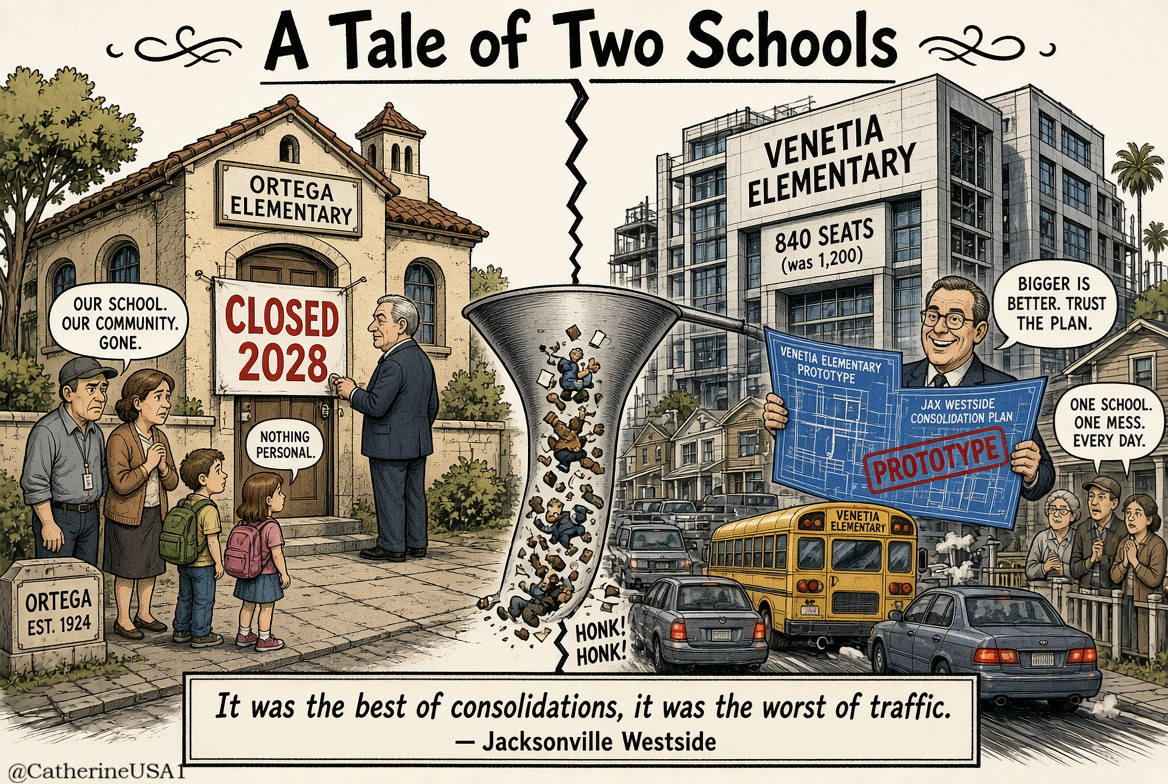
The Duval County School Board and the central office spent the better part of 2026 treating the Venetia neighborhood like a blank spreadsheet cell.
Venetia Elementary, a 1942 building on Timuquana Road with roughly 350 kids, was going to be razed and replaced with a 1,200-seat “prototype” elementary.
Ortega Elementary, under 300 students, would be shut after 2027–28 and folded in. The original shut date was 2030.
The other 500 or 600 seats? Boundaries “to be determined later.”
Cost figures floated as high as the $70–75 million range before staff promised it would come in “well under $50 million.”
And the first concrete ask was a $2.2 million preconstruction contract so the design could start before anyone had answered the obvious questions.
Neighbors did the unglamorous work the district skipped.
They printed flyers, knocked on doors, and showed up.
They pointed out that Timuquana already backs up when the current school lets out.
They noted the site is landlocked, that drainage is already a local obsession, and that a neighborhood school you can walk or bike to is not the same thing as a regional campus fed by buses from somewhere else.
They asked, repeatedly, where the extra kids were supposed to come from.
The answers stayed vague because the real driver was utilization math and a 2019 facilities plan, not a traffic study or a straight conversation with the people who live there.
Neighbors on Timuquana are not inventing the traffic. A school that currently serves a few hundred kids does not magically absorb Ortega plus five new pre-K rooms without a car line that backs into the streets.
The process made it worse. Ortega’s closure advanced with the kind of quiet procedural speed that makes people assume the outcome was decided before the microphones were turned on.
Community meetings arrived with thin notice. A surplus-property move on Ortega drew the same complaint: the district was writing the ending before it finished the chapter.
The district ran a traffic study after the shouting started.
Parents at both schools said the process skipped its own rules.
Stockton families started asking who else was quietly next.
Superintendent Christopher Bernier eventually told a packed room he was “hearing” the Venetia community “very, very clear.” Hearing is cheap.
The $2.2 million contract still came up for a vote.
On September 1 the board finally blinked, 6–1, with only Tony Ricardo in favor. Chair Charlotte Joyce said the district had lost trust and had to get it back. That vote was the correct one, and it only happened because residents forced it.
A board that needs a hallway full of angry neighbors before it slows a multi-tens-of-millions project is not exercising oversight. It is reacting to embarrassment.
The revision that followed is not a conversion. Staff came back with 840 seats instead of 1,200, Italian-revival trim so the box looks less like a box, a traffic study, and a car queue sized for more vehicles than the model says it needs.
Ortega is still closing. Five VPK classes are still being added. The price is still in the neighborhood of $50 million. Approval is still aimed at a November board meeting, with an opening target of 2028.
Some Venetia parents, reasonably, want the falling-apart building replaced and said so; at the September 29 meeting they got booed by people who think the trees and the road matter too.
Both groups are arguing past a district that treated “right-sizing” as a mandate and community consent as a scheduling problem.
This is what the half-penny sales tax politics always risk becoming. Voters were sold repairs and smarter facilities.
What they got on the Westside was a prototype campus dropped onto a street that already fails at one-third the proposed load, justified by payroll efficiency and a Polk County-shaped floor plan, with the hard questions deferred until after the contract.
Consolidating two small elementaries can be defensible. Building a much larger school on a constrained site, while refusing to say who else is coming, and then acting surprised when the zip code objects, is not management.
It is a preference for clean capacity numbers over the actual place.
The September vote proved the board can still be moved.
The October “compromise” proves the central office would rather resize the same plan than abandon the premise.
Until Duval stops designing the school first and discovering the neighborhood second, every future closure is going to look like Venetia: a fight the district scheduled, then claimed it never saw coming.
A tale of two schools, sure—except both of them are being written by the same central office.